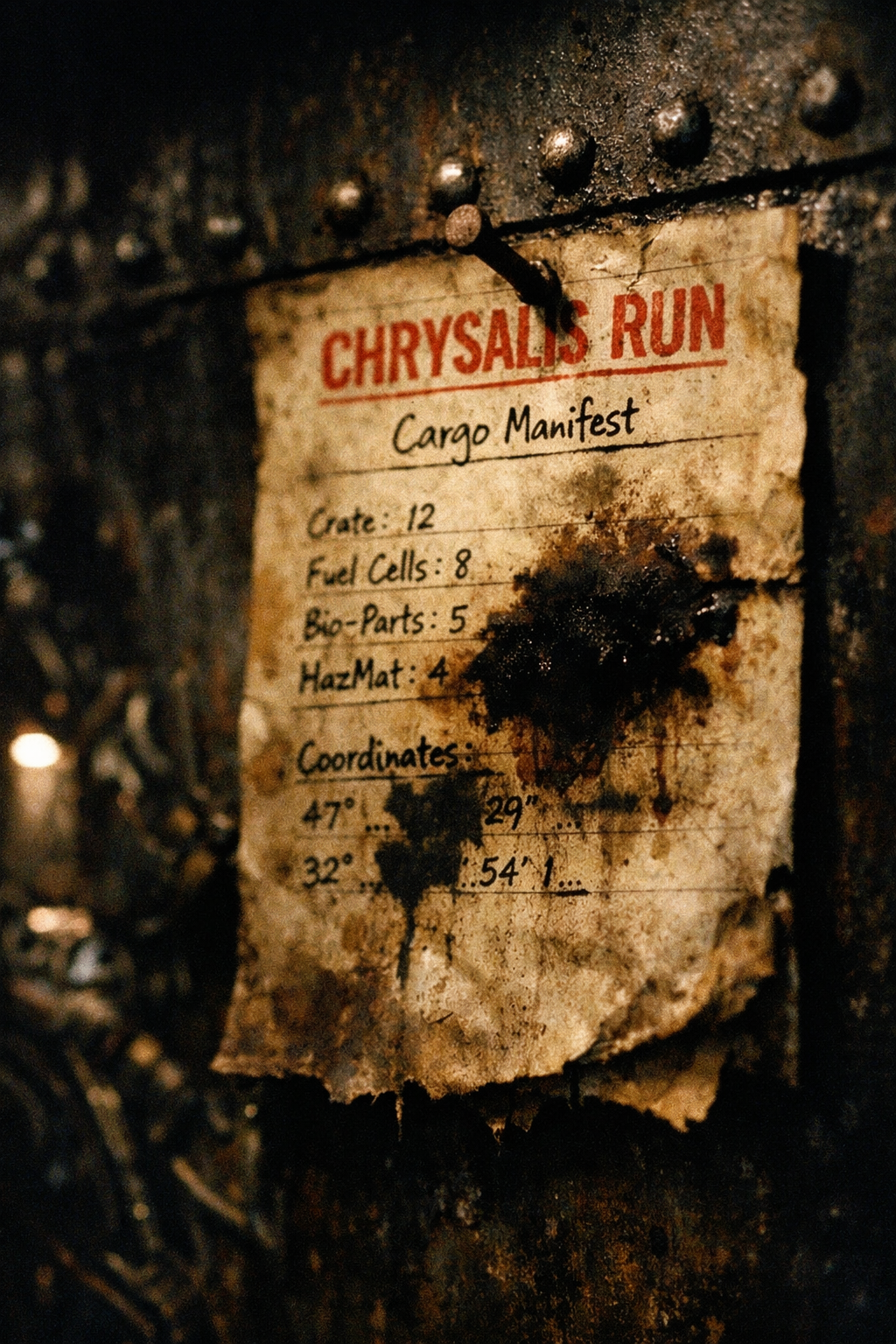
CHRYSALIS RUN
I.
Mara Sek hadn't slept in thirty-one hours and the coffee was gone.
Not finished. Gone. The recycler had chewed through its last filter two stops back, and the replacement she'd been promised at Harlan Depot turned out to be for a different model. So now there was a dead machine bolted to the galley wall, and she was running on spite and the sour taste of stim tabs dissolving under her tongue.
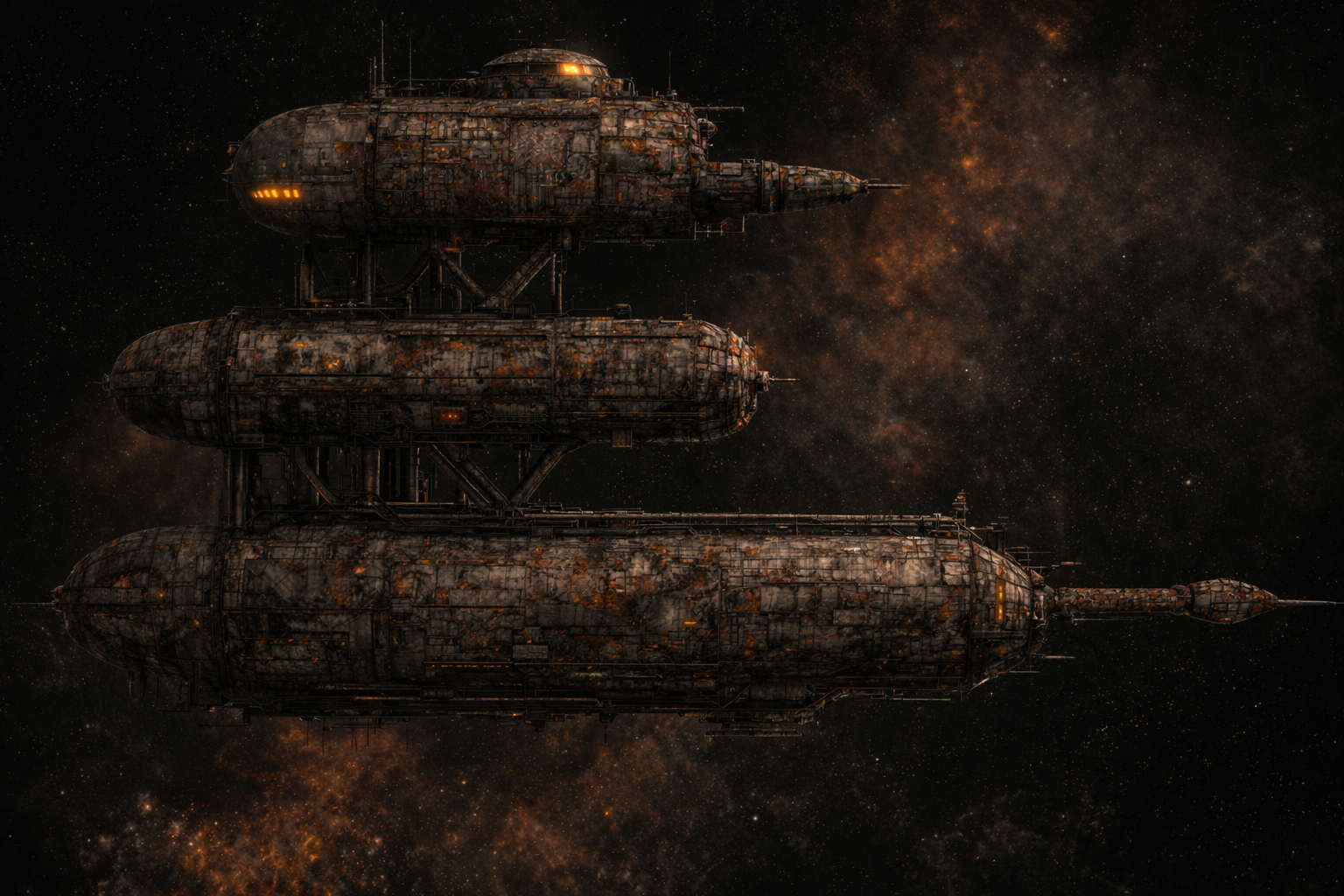
The ship was the Carrion Plea. Three cylindrical pressure hulls stacked and bridged by vertical pylons. It had been a survey vessel once, back when survey vessels still got funding. Now it was whatever it needed to be. Freight hauler. Courier. Extraction platform. Anything that matched a manifest and paid in something they could use.
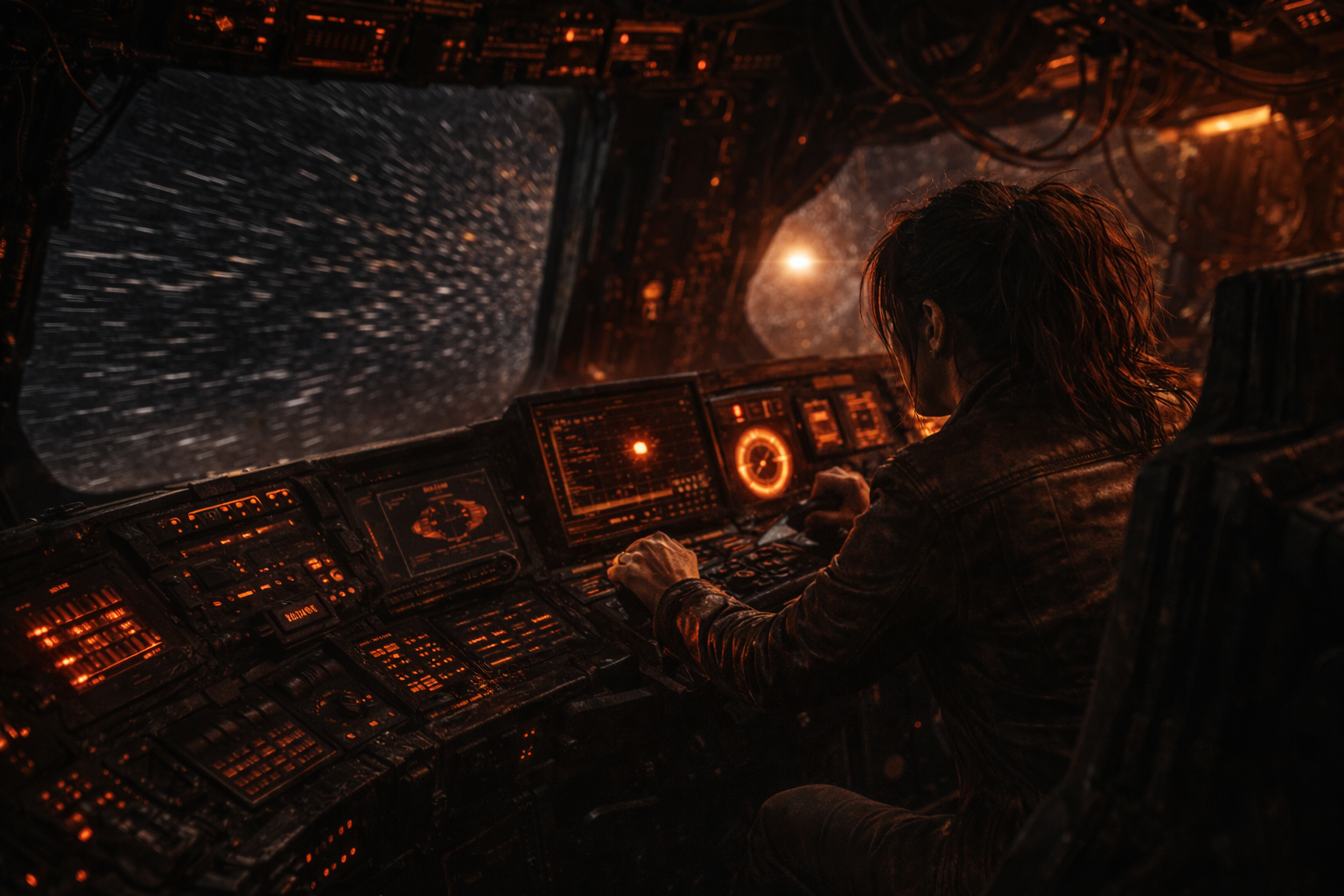
She sat in the captain's chair, a bolted-down wreck of cracked gel padding and exposed frame, and watched the forward display paint the dark in pale blue gridlines. Ring 1 space. Sparse traffic. The kind of empty that means nobody's making money, which means the people who are out here are either lost or doing something they don't want seen.
"Koss," she said.
Nothing.
"Koss."
The intercom coughed static. Then: "I heard you the first time. I'm elbow-deep in the number three conduit junction and if I let go of this bypass the port hull loses pressurization, so unless you're about to tell me we're on fire, give me ninety seconds."
Mara waited ninety seconds. She counted them.
"We're not on fire," she said. "But we've got a manifest."
II.
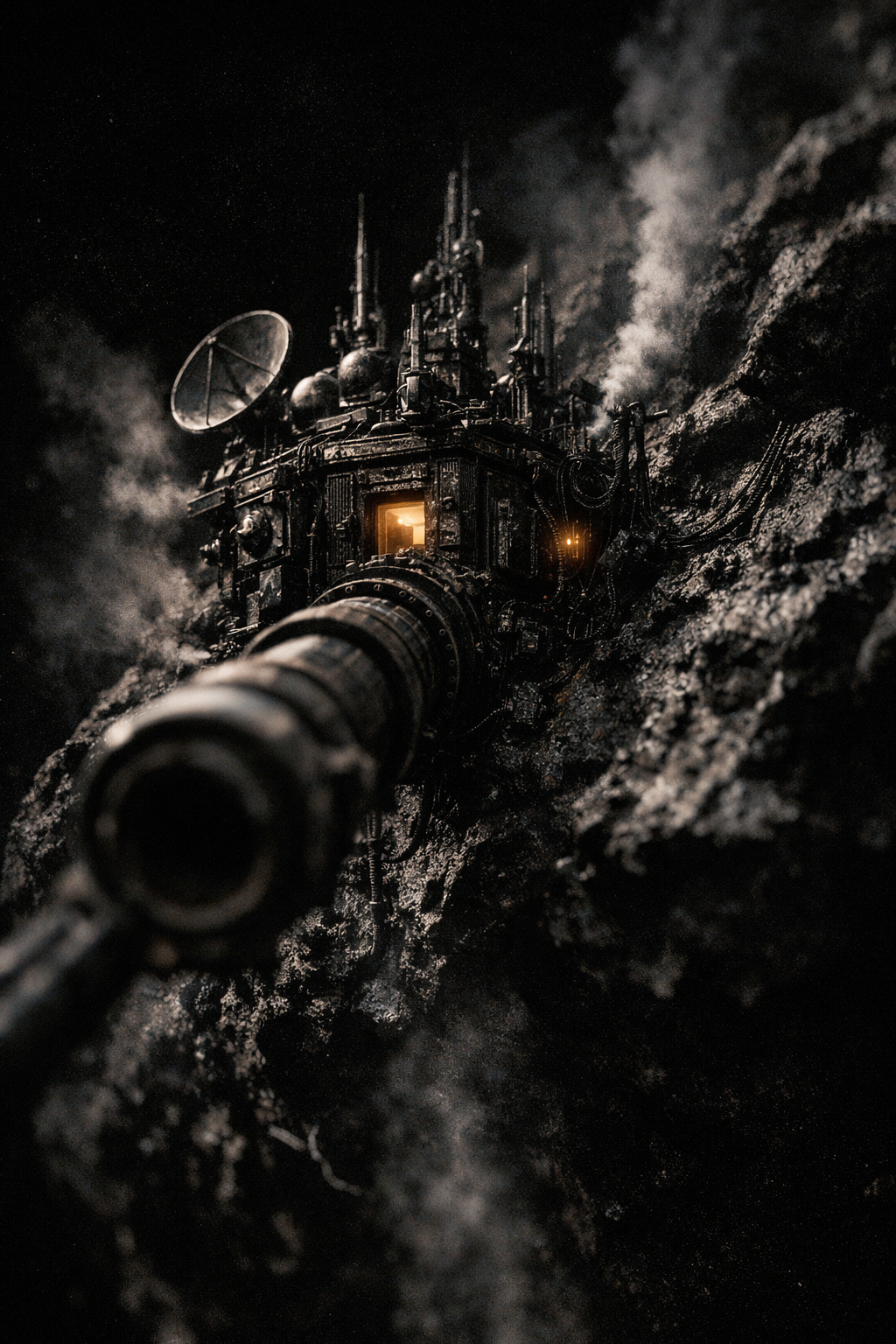
The manifest came through a port handler named Dace who operated out of a signal relay station bolted to the side of a dead comet. Dace was not a person you trusted. Dace was a person you used, the way you use a vending machine. You put the right input in, you get the right output, and you don't wonder about its feelings.
The job was simple on paper. Biological research samples. Sealed containers. Pickup from a corporate depot at the edge of Ring 1. Delivery to a research station called Fleischer-Yun, eighteen sectors deep into Ring 2. Payment: reactor couplings, a thermal refit kit, and a full coolant purge. Six weeks of life, bolted to the wall and humming.
"That's Ring 2 money," said Tomás, their gunner, leaning against the bridge doorframe with his arms crossed. He was twenty-four and still thought that meant something. "They're paying Ring 2 money for a cargo run."
"Because it's a Ring 2 destination," Mara said.
"Nobody pays fair for a cargo run. Ever. You taught me that."
She had. She wished he'd learn the other thing she'd taught him, that knowing a job stinks and turning it down are two different luxuries, and they could only afford one.
Koss pulled herself up through the deck hatch, wiping conduit grease on her thighs. She was older than Mara by a decade and looked older than that. Her hands were mapped with burn scars from a lifetime of reactor work, her hair cropped short because long hair near magnetic coils is how you go bald the fast way.
"I heard Ring 2," Koss said. "What's the catch?"
"Biological cargo. Sealed. No inspection."
"So we don't know what it is."
"We know what it pays."
Koss looked at her. The look that said I've opened holds I wasn't supposed to, and I'm still here, and that should scare you.
"Coolant purge?" Koss asked.
"Full purge. Plus couplings."
Koss wiped her hands on her pants again, even though they were already clean. A habit. Something to do while she decided.
"Alright," she said. "But I'm sealing the cargo hold ventilation. Whatever's in there breathes its own air."
III.
The pickup was at a corporate depot, an unmanned platform in a decaying orbit around a gas giant the color of a bruise. No people. Just a docking clamp, an automated cargo transfer system, and a manifest confirmation ping that validated their codes and released the freight.
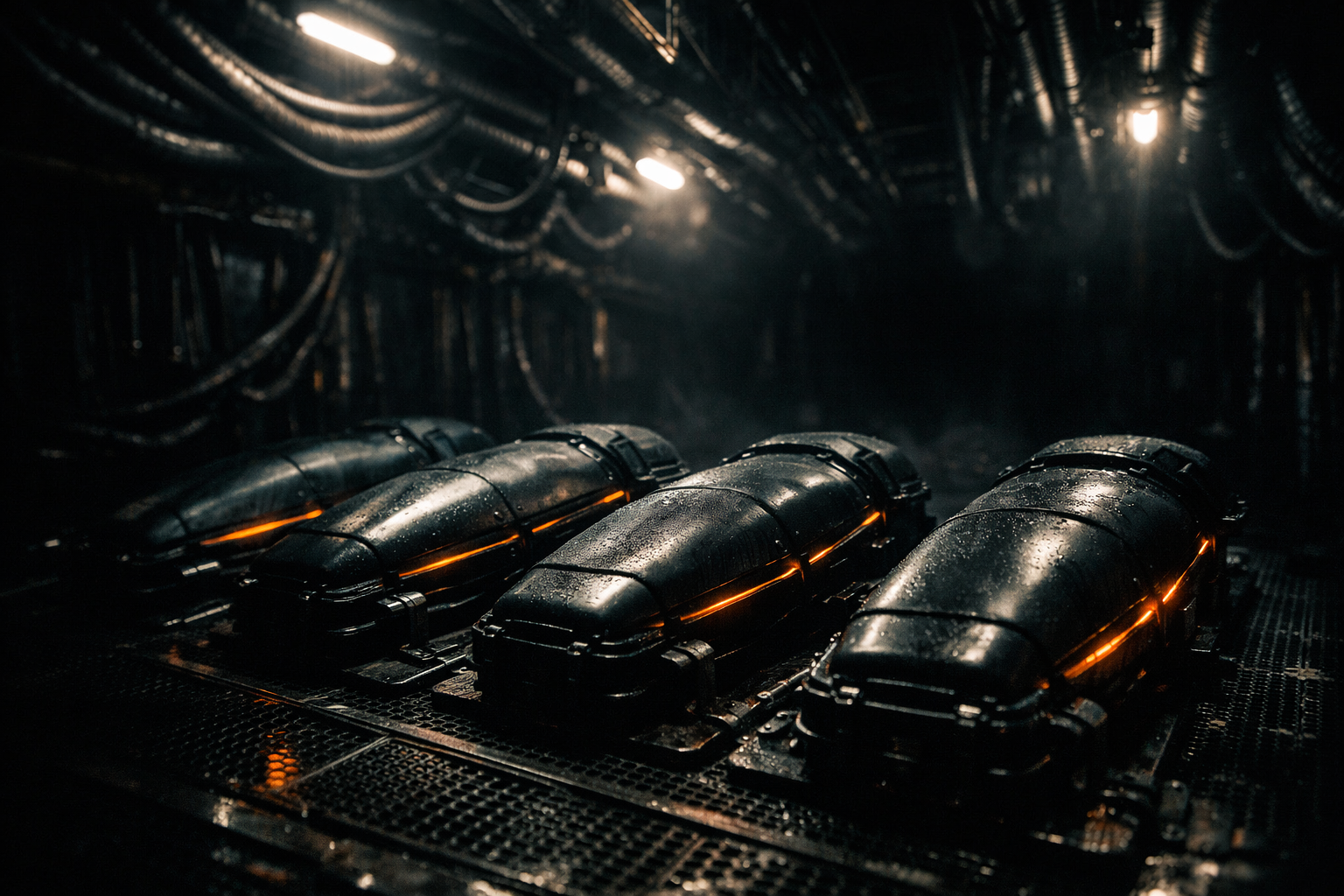
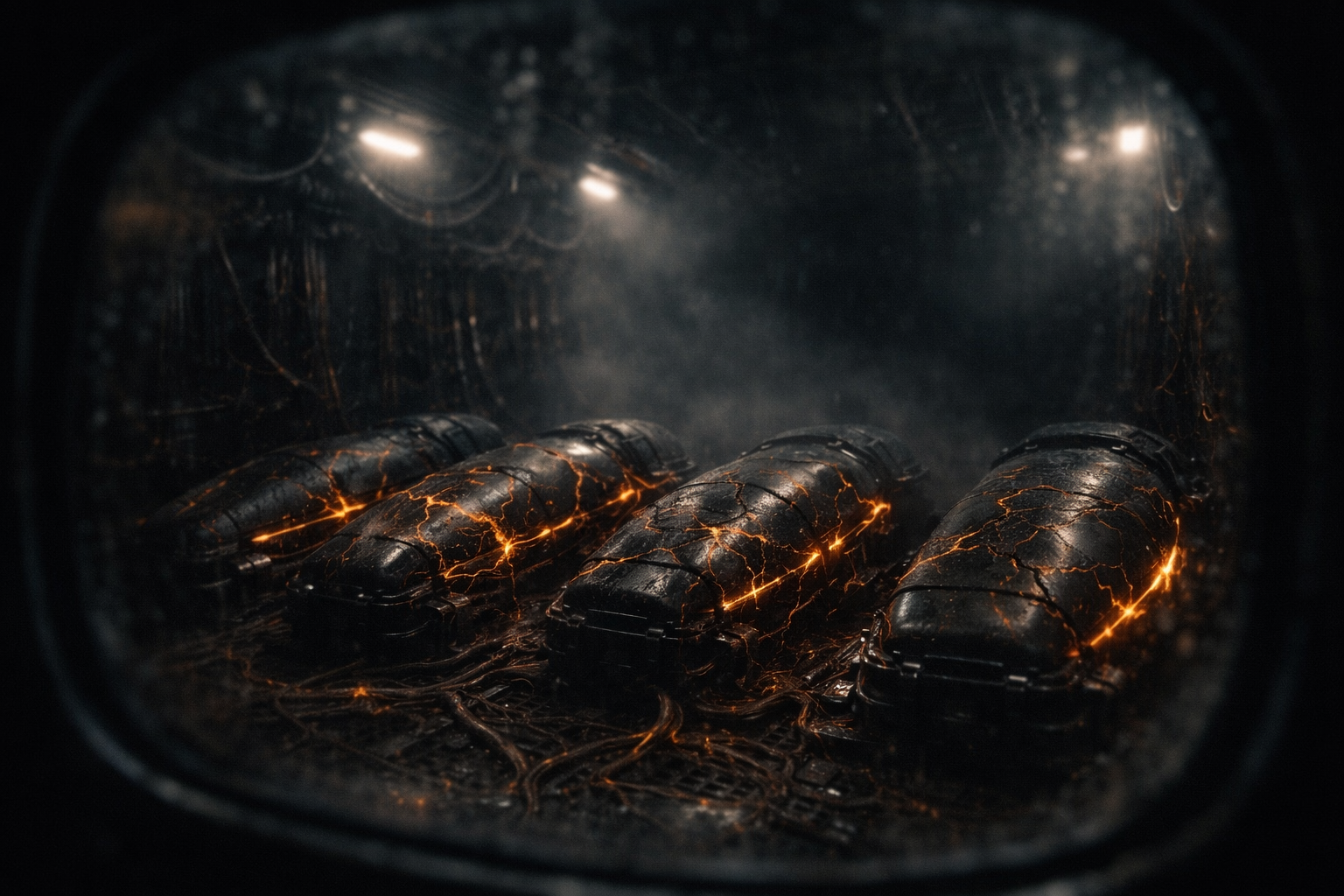
Four containers. Matte black. Unmarked except for serial numbers etched into the surface. Not printed. Etched, like someone had used a medical laser. Each container was roughly the size of a person lying down. They were warm to the touch.
Tomás stood in the cargo hold watching the deck clamps lock them into place. The hold was the belly of the lower hull: exposed structural ribs, conduit bundles running along the ceiling in thick loops, grated steel over the fuel tank housings below.
"They're warm," he said over comms.
"Biological samples," Mara said from the bridge. "They're probably in stasis. Stasis requires thermal regulation."
"They don't have power hookups."
Silence on the line.
"Mara. These containers are not connected to anything. They're warm on their own."
"Get out of the hold, Tomás."
IV.
Twelve hours into transit, the thermal management system flagged an anomaly.
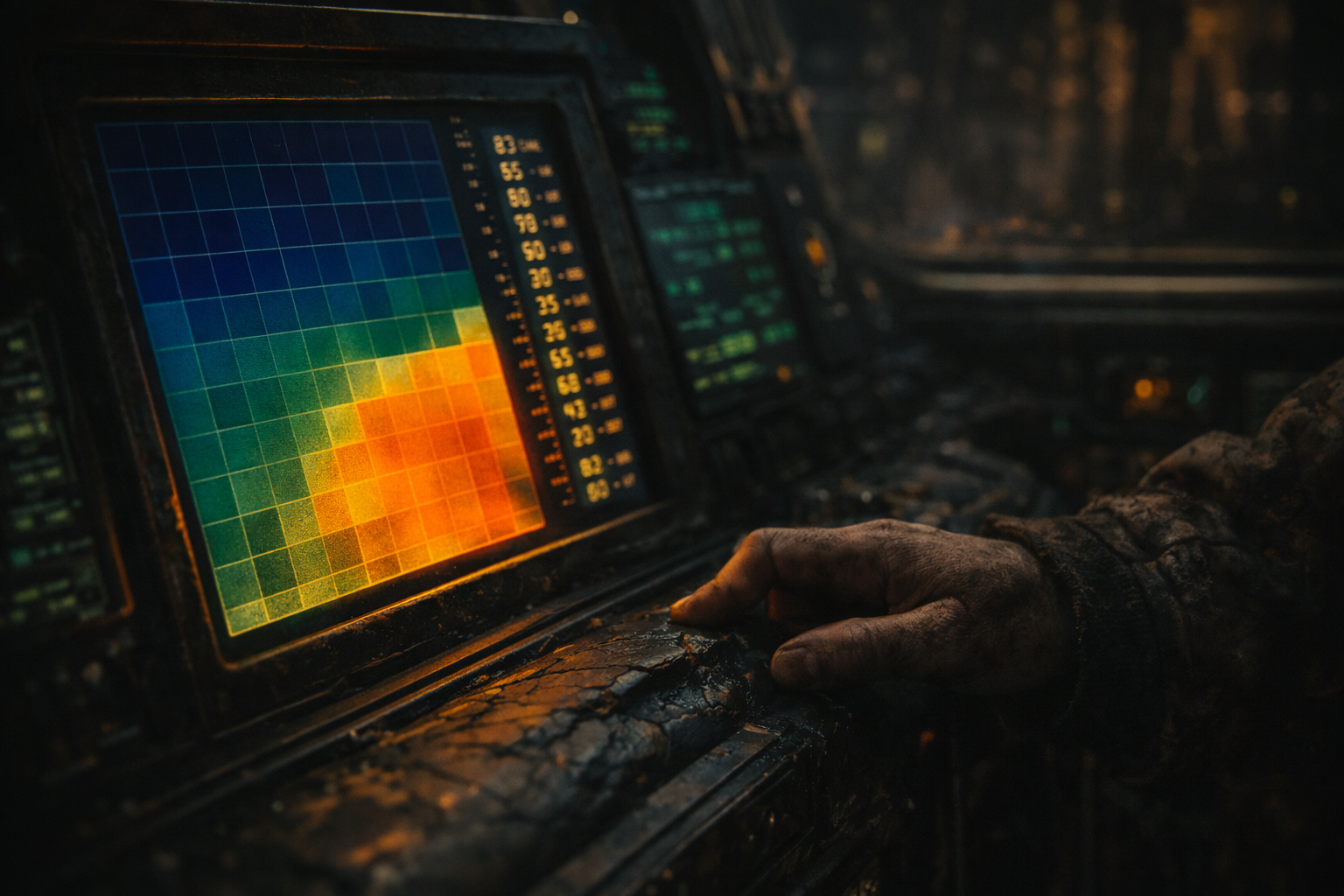
Mara was half-asleep in the captain's chair, her thumbnail working at a crack in the gel padding she'd been picking at for weeks, when the alert pulsed. Not the hard red of a reactor warning, but the amber of something off. She pulled up the thermal overlay. The ship's heat map rendered in gradient: blue for cold, green for nominal, yellow for warm, red for danger.
The reactor was green. The drive was green. Life support was green.
The cargo hold was yellow. And climbing.
She opened a channel. "Koss. Lower hull thermals. Tell me what you see."
The response took thirty seconds. When Koss spoke, her voice was flat. Controlled.
"The containers are generating heat. Roughly 400 watts combined. It's not much, but it's enough to register on the thermal loop. The cargo hold isn't designed to reject heat. It's a cold space. The excess is migrating up through the pylons into the central spine."
"Into the radiator system."
"Yes. Which means it's being radiated. Which means..."
"Our EM signature is climbing."
"By about six percent so far. In Ring 1 that's noise. In Ring 2, that's a lighthouse."
Mara stared at the thermal overlay. The yellow blotch in the cargo hold was shaped like a handprint.
"Can you insulate it? Reflect the heat back into the hold?"
"I can try. But if whatever's in there is metabolizing, if it's alive and producing heat as a byproduct, then reflecting the heat back just cooks it. And if it cooks, we don't deliver, and we don't get paid."
"Then we vent it. Controlled thermal bleed into the fuel tank housing below. Use the fuel mass as a heat sink."
"That'll warm the fuel. Warm fuel changes the injection profile for the drive. I can compensate, but it's going to eat our burn efficiency."
"Do it," Mara said. "And Koss, don't open those containers."
"I wasn't going to."
"I know. I'm saying it anyway."
V.
Sixteen hours in. They crossed into Ring 2.
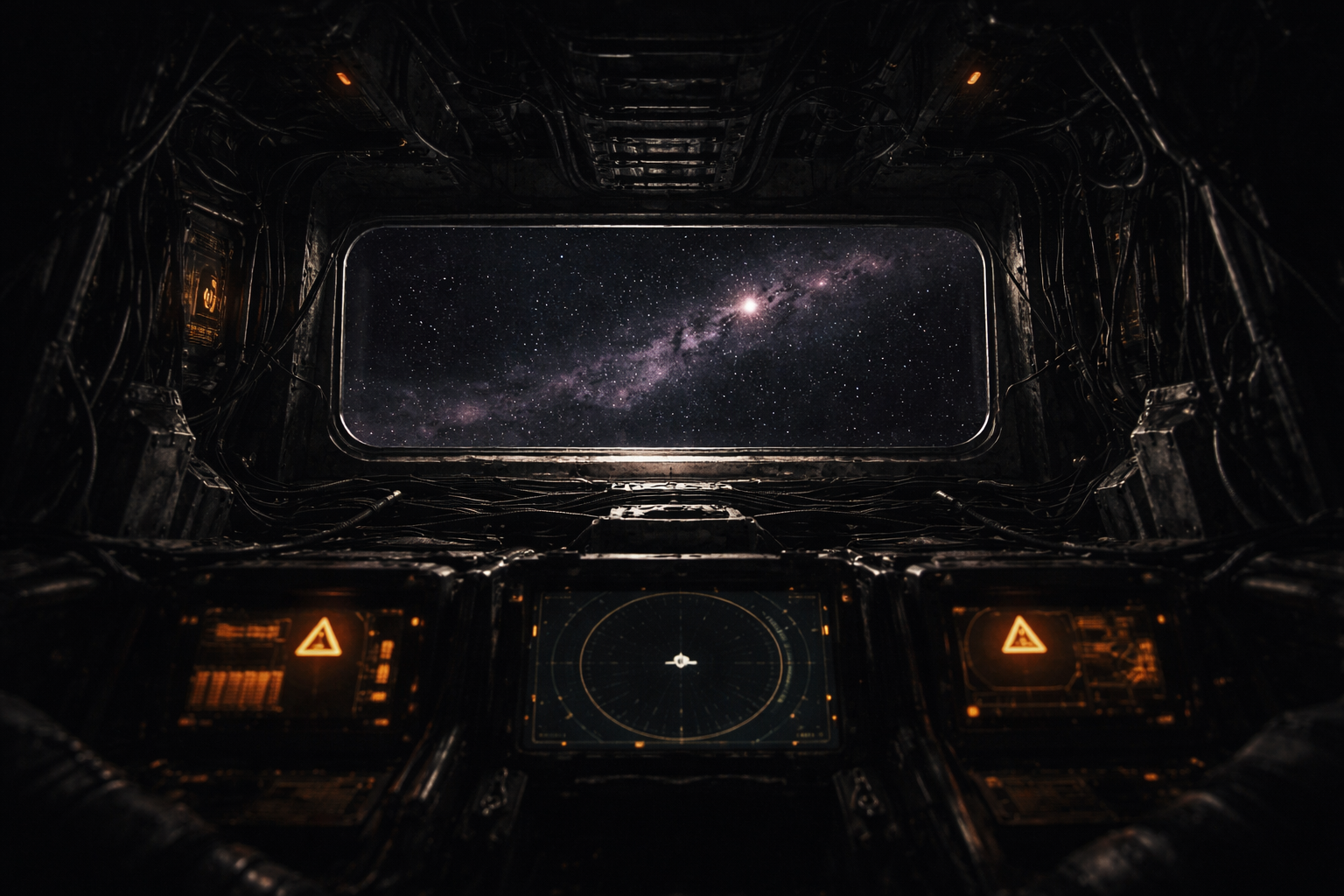
There was no border. No gate. Just a navigational designation that changed on the display, and with it, the math. Ring 2 meant longer sensor ranges on hostile contacts. Denser debris fields, heavier radiation, and the kind of traffic that didn't file flight plans. It meant that the six percent signature bump from the cargo went from inconvenient to potentially fatal.
Tomás was running passive scans from the bridge when he picked up the first contact. Range indeterminate; the radiation background was smearing the returns. But it was there. Something running parallel to their course, matching their heading.
"Could be a freighter," he said.
"Freighters don't match heading," Mara said. "They transit. They have somewhere to be."
"So do we."
"Pull the active array. Go dark on sensors. Use thermals only."
Tomás hesitated. Running blind in Ring 2 was like closing your eyes on a highway. But active scanning was a shout in a quiet room, and everyone hears a shout.
He killed the active array. The bridge display simplified. Crisp radar-style contacts replaced by gauzy, uncertain blobs of thermal detection. Their contact was still there. A warm smear against the cold background, tracking them.
From below, through the deck, Mara felt something she shouldn't have. A vibration. Not the engine. Not the reactor. Something low and irregular, like a pulse.
She looked at the floor.
VI.
Twenty hours in. Mara went down to the cargo hold.
She told herself she was checking the thermal bleed setup. That was true. She told herself she needed to visually confirm the container integrity. Also true. What she didn't tell Koss, or Tomás, or herself, was that she could feel it now. A presence in the lower hull that had weight to it, a pressure change that wasn't on any gauge.
The hold was warmer than it should have been. Koss's thermal bleed was working, the fuel tank housing below absorbing the excess, but the air still felt thick. Humid. The deck grating smelled like hot pennies. She could see her breath, which made no sense. If the hold was warm, she shouldn't see her breath. Unless the moisture content in the air had spiked.
The containers were sweating.
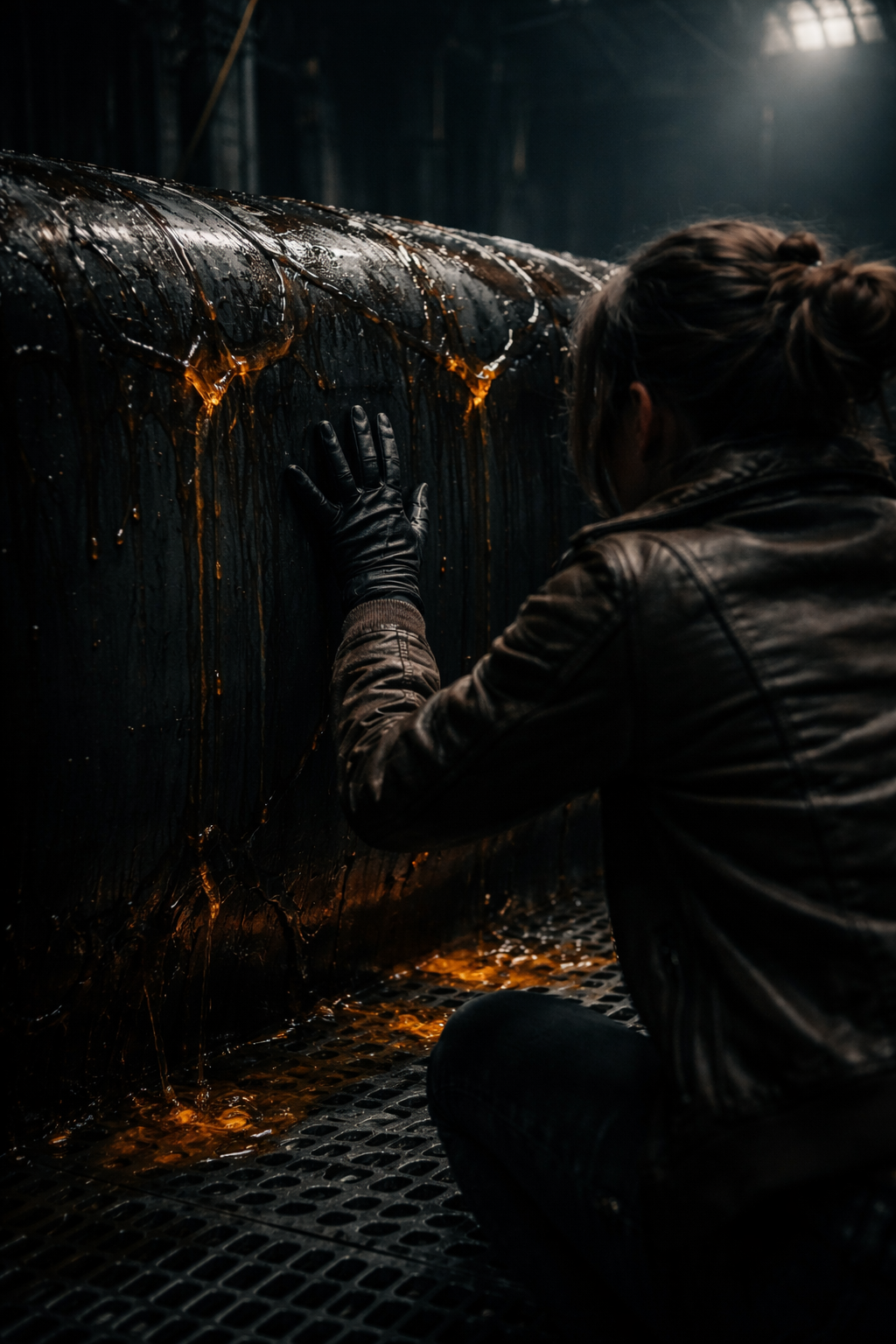
Not metaphorically. Condensation beaded on their matte black surfaces and ran in thin rivulets down the sides, pooling on the deck grating. The fluid wasn't water. It was viscous, amber-tinted, and it caught the overhead light in ways that made it look like it was moving on its own.
Something turned over in Mara's chest. A recognition she refused to follow. She knew that color. That exact amber, that exact viscosity — she'd seen it before, in a hold on a different ship, in a uniform she wasn't supposed to have worn, writing a report that someone with more rank and less conscience had made disappear.
She looked at the fluid on the deck grating and told herself it wasn't the same thing.
She'd had years of practice telling herself that.
Mara crouched next to the nearest container. The etched serial number was partially obscured by the fluid. She wiped it clear with her thumb and immediately regretted it. The surface under the fluid was warm the way skin is warm.
She pressed her palm flat against the container.
Under her hand, something pressed back.
Slow pressure, like a palm meeting hers from the other side. Matching her hand's shape. Matching her warmth.
She pulled away. Wiped her hand on her jacket. Looked at the amber fluid on her fingers. It was already absorbing into her skin.
VII.
"We need to talk about what's in those containers."
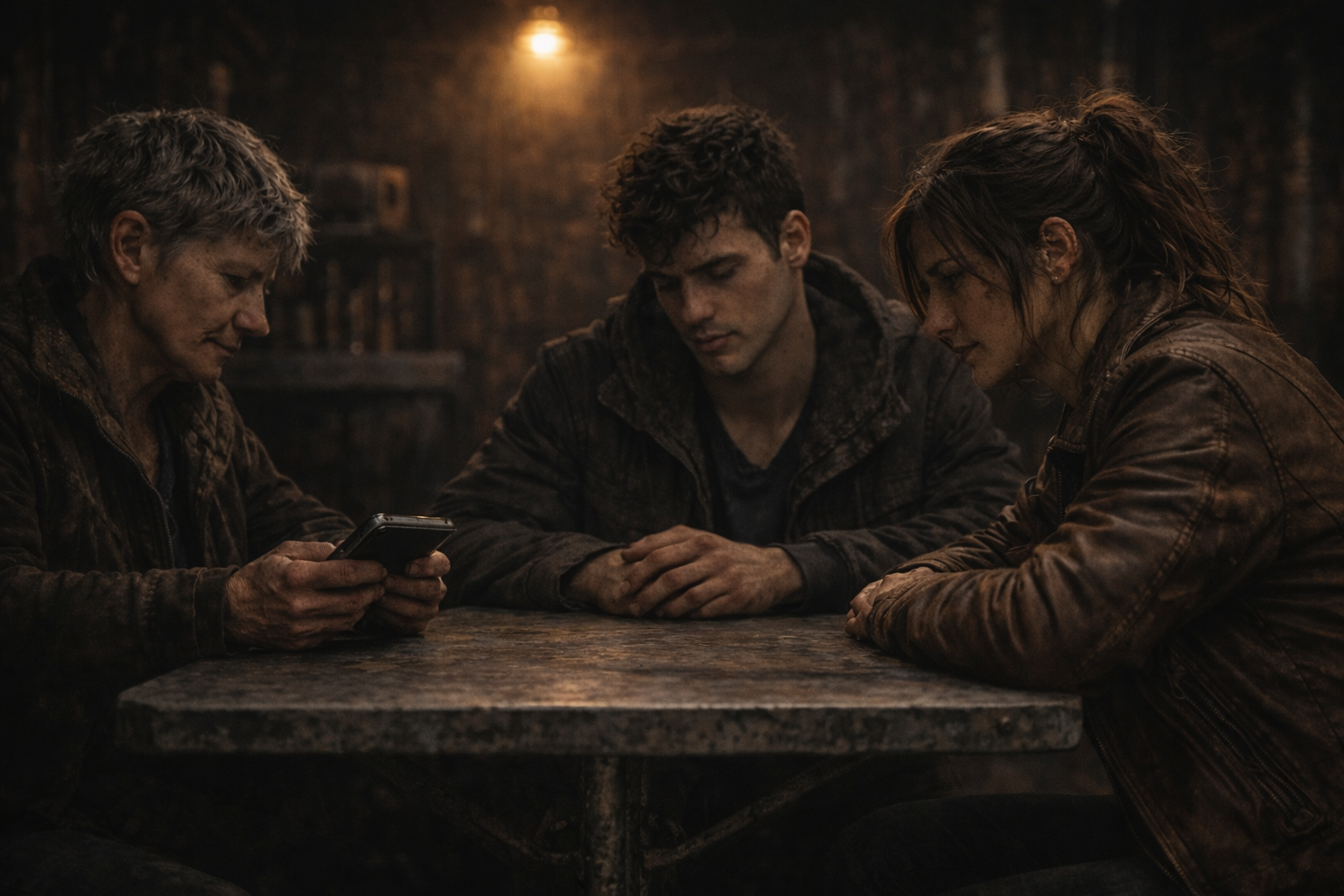
Koss and Tomás sat across from her in the galley. The galley was a narrow slot between the bridge and the crew berths in the upper hull: a fold-down table, magnetic cupholders, the dead coffee recycler. The closest thing to neutral ground the ship had.
"Biological samples don't have body heat," Mara said. "They don't sweat. They don't respond to contact."
"You touched one," Koss said. Not a question.
"I put my hand on the surface. Something inside matched the pressure. Palm to palm. Through the casing."
Tomás leaned forward. "So we're hauling people."
"No. People don't generate enough heat to shift a ship's thermal signature. People don't sweat through sealed containers. Whatever's in there is biological, but it's not human. Or it's not only human."
Koss pulled up the manifest on her datapad. The cargo description read: Preserved xenobiological samples, inactive. Class 4 containment. Do not breach seal. Do not expose to external atmosphere. Maintain ambient temperature. No special handling required.
"Inactive," Koss read. "These aren't inactive. These are the opposite of inactive."
"What's the opposite of inactive?" Tomás asked. He was pulling at a seam on the table's edge, not looking at either of them.
"Waking up."
The ship creaked around them. Thermal expansion in the port-side pylon, metal growing as heat migrated through the structure. The containers were warmer now. The whole ship was warmer.
"Here's what I know," Mara said. "We're eighteen sectors from Fleischer-Yun. Our EM signature is running eight percent above baseline and climbing. We have a contact tracking us that's either hostile or too curious for comfort. The cargo is generating heat we can't fully sink, and whatever's inside is becoming more active, not less."
"And here's what I don't know. What happens when it finishes waking up."
"Option one. We vent the cargo. Blow the hold, dump the containers into the void. Our signature drops to baseline. We run dark. We lose the payday, which means no couplings, no thermal refit, no coolant purge. We limp back to Ring 1 and hope the number three conduit junction holds long enough to find another manifest."
"How long will it hold?" Tomás asked Koss.
"Weeks. Maybe. If nothing goes wrong." She said if nothing goes wrong the way a doctor says if the bleeding stops.
"Option two. We push. Eighteen sectors at current burn, signature blazing. We deliver whatever this is to Fleischer-Yun, we take our payment, and we leave. What they do with it after that isn't our problem."
"Isn't it?" Tomás said.
"We're not the law, Tomás. We're not a relief organization. We're not a military vessel. We are a crew of three on a ship that is failing, and we need those parts, or we die. We just stop. The reactor drifts out of confinement. The thermal system can't compensate. The ship cooks us from the inside out. That's what happens if we dump this cargo."
"And if we deliver it? If whatever's in those containers finishes waking up in their lab? What happens to the people it wakes up next to?"
"That's their problem. They bought it. They know what it is."
"Do they?"
VIII.
Twenty-four hours in. The contact was closer.
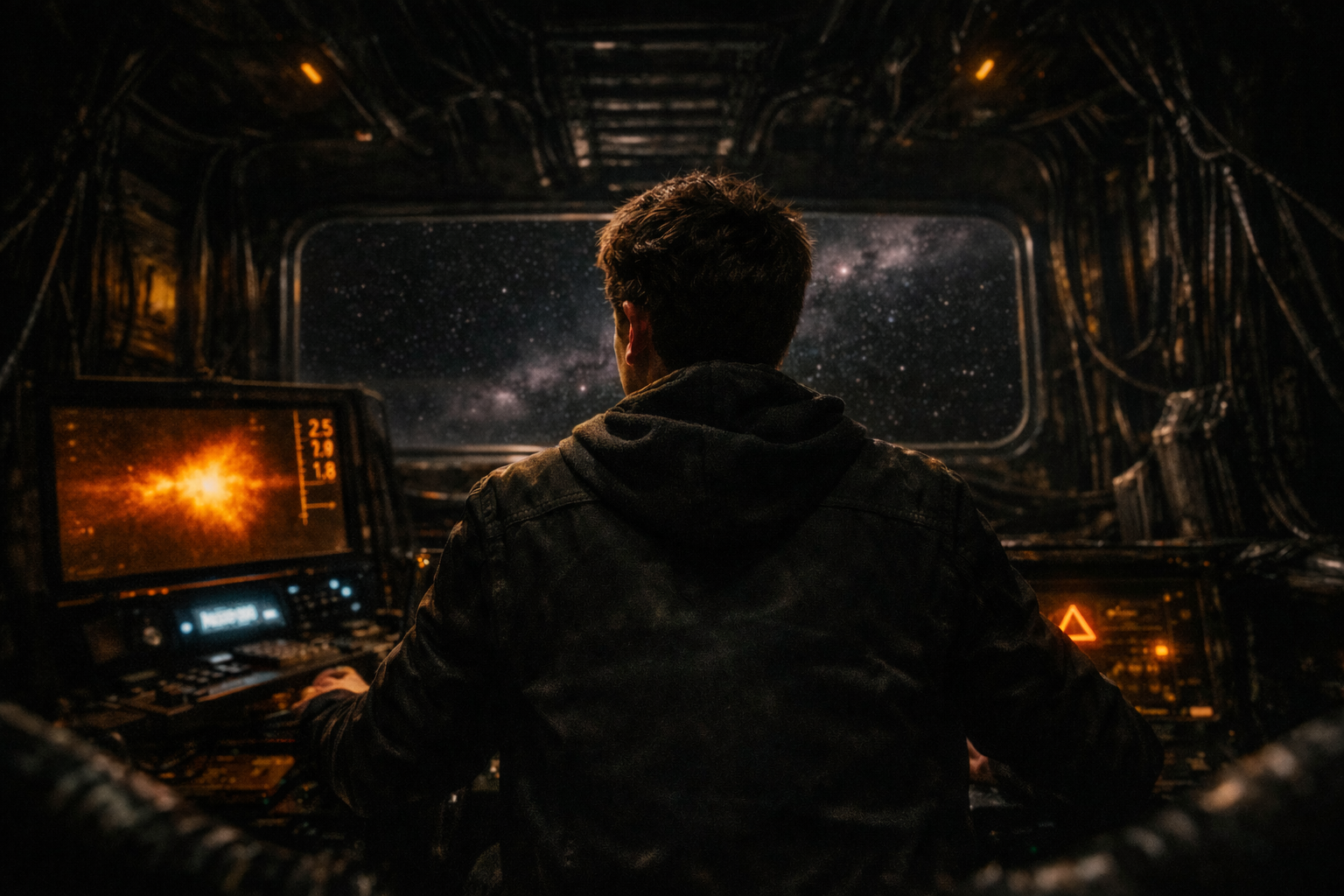
Tomás had been tracking it on thermals for eight hours. It was no longer matching their heading. It was converging. Slow, patient, the way something converges when it knows you can't run without lighting up brighter.
"It's reading our signature," he said. "It knows we're running hot. It's waiting for us to spike, a course correction, a burn, anything that pushes our output up. Then it'll have a solid fix."
"Can we go cold? Drop everything to minimum, coast on inertia?"
"For how long? The cargo is still generating. Even with everything else dark, those containers are pumping enough heat to keep our radiators lit. We can't go invisible while we're carrying that."
Mara made the call.
"Koss. I need you to do something to the cargo."
"I'm not opening them."
"I'm not asking you to open them. I need you to cool them. Actively. Reroute coolant from the secondary loop through the hold. Bring their surface temperature down. Slow whatever's happening inside."
"That pulls coolant from the drive thermal management. If the drive overheats..."
"I know."
"We lose propulsion, Mara. We're dead in Ring 2 with a hostile contact bearing down on us."
"I know. Do it in stages. Ten percent coolant diversion to start. Monitor the drive thermals. If they climb above tolerance, we pull back."
"And if ten percent isn't enough to cool the cargo?"
"Then we go to twenty. And we find out how much ship we're willing to sacrifice to keep those things asleep."
IX.
At thirty hours, Koss called from the cargo hold. Her voice was wrong.
"Captain. You need to see this."
Mara climbed down through the pylon accessway, a vertical tube of ladder rungs and conduit bundles, the metal cold under her hands because the coolant reroute had chilled the structural members. She dropped into the lower hull corridor and walked aft to the hold.
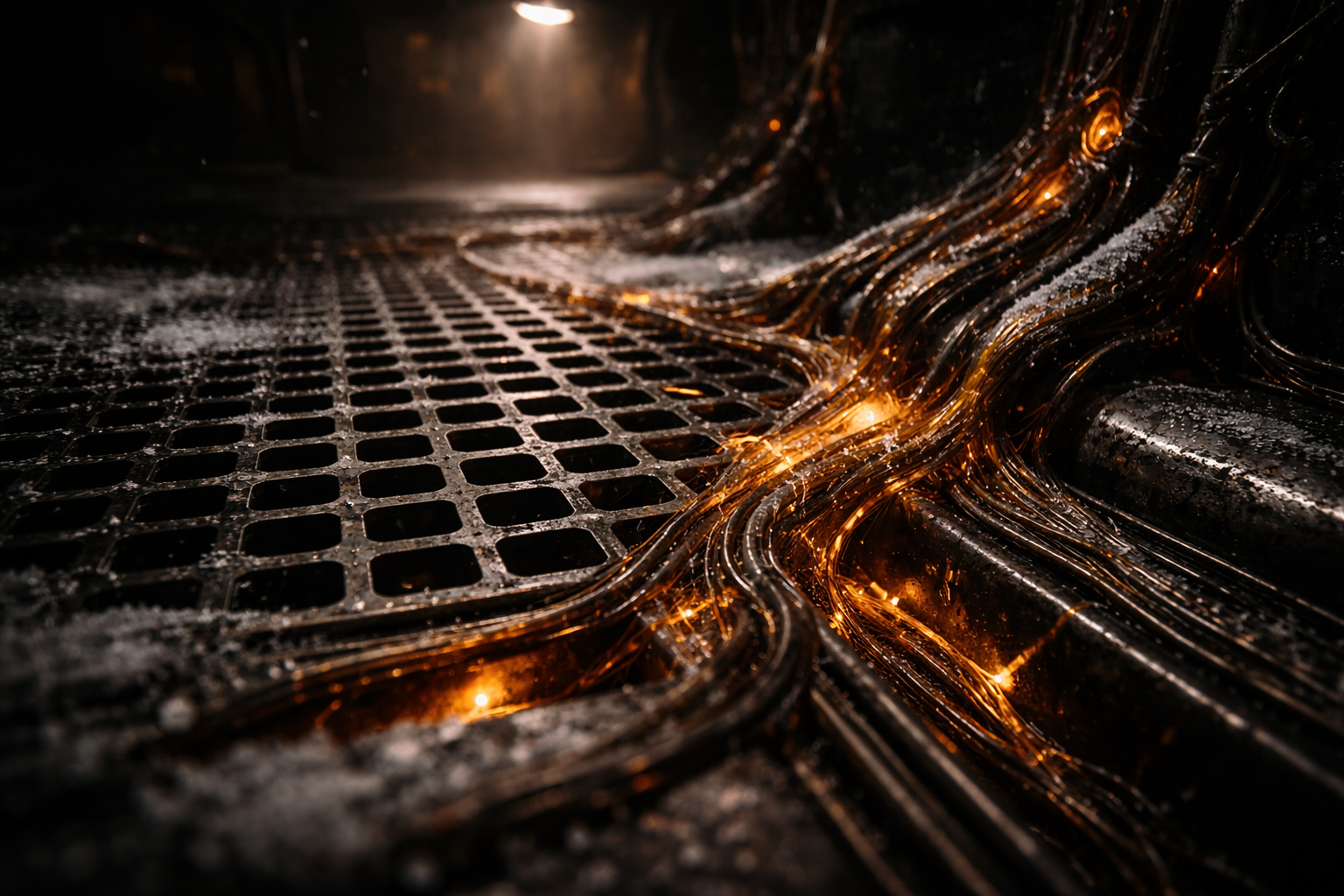
The hold was cold now. Koss's coolant diversion was working. Frost crept along the structural ribs, and the air bit at exposed skin. The containers had stopped sweating. But something else had happened.
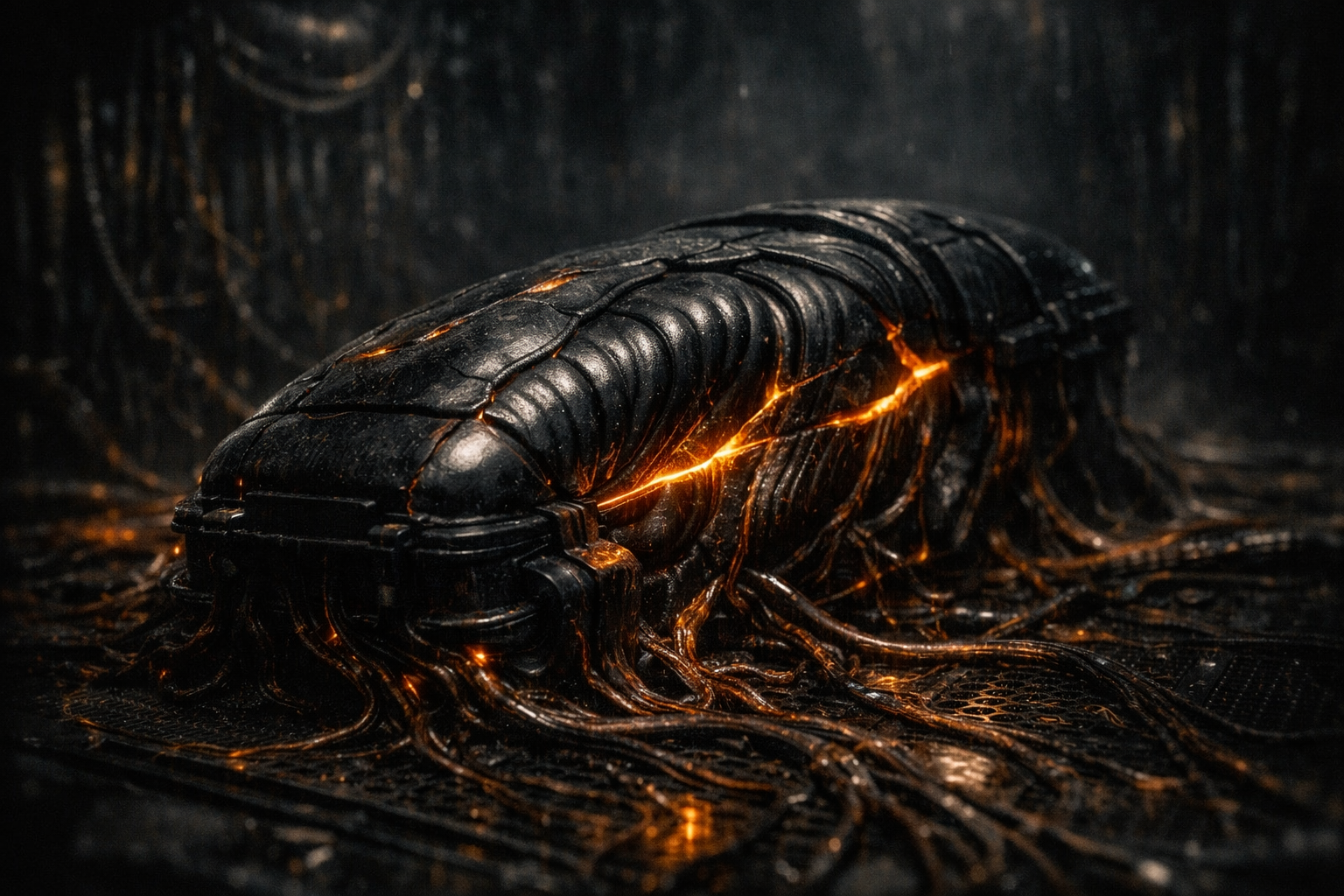
The amber fluid that had pooled on the deck grating hadn't evaporated in the cold. It had organized. Thin filaments spread from the puddles, threading through the grating, following the conduit channels in the deck, reaching toward the nearest bulkhead junction like roots seeking soil. Where the filaments touched metal, they had bonded. Fused. The boundary between organic material and ship structure was blurring.
"It's integrating," Koss said. She was standing as far from the containers as the hold allowed, her back against the aft bulkhead. "The fluid isn't waste product. It's connective tissue. It's trying to attach to the ship."
"Can you remove it?"
"I scraped some off the grating near the hatch. It came away clean. But the deeper strands, the ones that have had time to set, they've bonded at a molecular level. I'd have to cut the deck plate out."
Mara looked at the containers. They were still now. Quiet. The cold had slowed whatever was inside. But the fluid they'd already shed was still working, still spreading, reaching through the ship's structure with blind patience.
She thought about the manifest. Preserved xenobiological samples, inactive.
"How far has it spread?"
"Just the hold so far. But the conduit channels in the deck run fore and aft through the lower hull. If it follows those channels, it reaches the fuel tank housing in about six hours. After that, the pylon junctions."
"And if it reaches the pylon junctions?"
"Then it's in the structural spine. Then it's everywhere."
X.
Thirty-two hours. Mara made the second call.
"Tomás. Weapons."
He looked at her from the tactical station. The weapons system had been offline since they'd bought the Carrion Plea, the power draw too heavy for their degraded reactor to support alongside propulsion and life support. Bringing weapons online meant something else went dark.
"What am I shooting?"
"Nothing yet. I want the system hot. If that contact closes to engagement range, I want options."
"We power weapons, we lose what? Sensors?"
"Sensors are already passive. We lose drive efficiency. Koss has already diverted coolant from the drive to cool the cargo. If we also pull power for weapons, our burn rate drops. Transit time to Fleischer-Yun goes from eighteen hours to twenty-six."
"Twenty-six hours with that thing growing in our hold."
"Yes."
"And the contact closing."
"Yes."
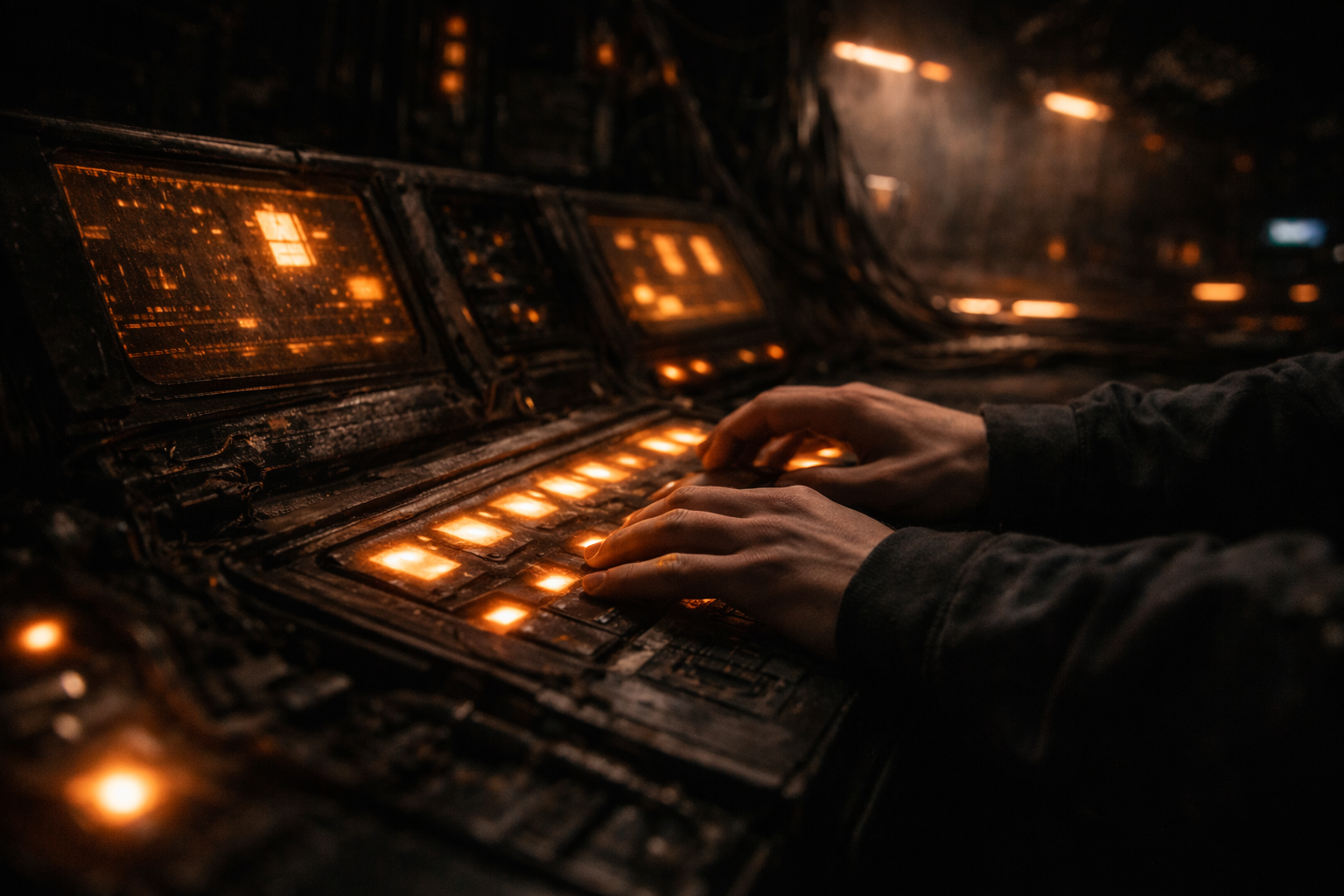
Tomás powered the weapons array. The ship shuddered, just the vibration of magnetic coils charging, capacitors cycling, another system demanding its share of a reactor that was already giving everything it had.
The lights dimmed. Not a flicker, a permanent reduction. The ship's power management redistributing load, pulling from habitability to feed the guns. The galley went dark. The crew berths dropped to emergency lighting. The bridge held, but barely. Displays at minimum brightness, life support fans cycling slower.
The bridge smelled like warm metal. Mara's back ached from sitting.
XI.
Thirty-six hours. Six hours from Fleischer-Yun. The contact made its move.
It came in fast once it committed. The thermal bloom of a hard burn, engines at full output, no longer trying to hide. On the passive display it went from a warm smear to a bright point, bearing down on an intercept vector.
"Corsair-class," Tomás said, reading the thermal profile. "Fast, light-armed, built for interdiction. They want the cargo."
"They want what's in the cargo," Koss said over the intercom from the lower hull. "Someone told them what we're carrying."
Dace. It had to be Dace. Sell the job, then sell the cargo's location to someone who wants it more. Standard Ring 2 business practice.
Mara ran the math. Six hours to Fleischer-Yun at current burn. The corsair would intercept in four. Their weapons were online but underpowered. The Carrion Plea was not a combat vessel, and the reactor couldn't sustain a prolonged engagement. One pass, maybe two. If the corsair was serious, they'd be boarded or disabled.
"Koss. How's the cargo?"
"Cold. Dormant. The coolant is holding it down. But the filaments are still spreading. They've reached the forward deck plates. I've been cutting them back, but they regrow within the hour."
"If I push the drive to full burn, can we outrun the intercept?"
"Full burn means I pull the coolant back from the cargo to cool the drive. The containers warm up. Whatever's inside wakes up faster. And our EM signature..."
"Goes through the roof. I know."
"Full burn," Mara said. "Pull the coolant. Let them warm up. We race the clock. Four hours to intercept, six to delivery. We need to cut that margin."
"And the corsair?"
"If it catches us, Tomás shoots it."
"With what power?"
"With whatever's left."
XII.
The containers woke up.
Not all at once. A cascade. The first one began generating heat within twenty minutes of the coolant withdrawal, surface temperature climbing from near-freezing to body temperature in a steady ramp. Then the second. Then the third and fourth together, as if they were communicating through the filament network that now threaded through thirty percent of the lower hull's deck structure.
Koss reported from the accessway between the cargo hold and the engine compartment. She'd retreated. The heat wasn't the problem anymore.
"They're shifting. Inside the containers. I can hear it. Slow movement. Repositioning. Like something unfolding."
The ship's thermal signature was screaming now. Drive at full burn, cargo generating freely, radiators dumping everything they had into the void. On passive sensors they'd look like a small star. The corsair didn't need to track them anymore. They could see them from across the sector.
Mara watched the navigation display count down the distance to Fleischer-Yun. Four hours, twenty-three minutes. The corsair intercept was in two hours, forty.
"Tomás. When they're in range, I need you to do something you're not going to like."
"I already don't like any of this."
"I need you to target the corsair with an active sensor lock. Full power. Paint them."
"That's a threat declaration. If they're armed, and they are, that gives them justification to fire."
"I know. But it also tells them we have weapons, and we're willing to use them. A corsair isn't a warship. They're built for soft targets. If they think we'll fight, they might recalculate."
"And if they don't?"
"Then we fight."
"We'll lose."
"Probably. But probably is better than certainly, and certainly is what happens if we do nothing."
Tomás nodded.
XIII.
The corsair broke off at ninety minutes.
It happened the way Mara hoped and didn't expect. Tomás lit them up with the active array, a hard sensor lock, every scanner they had pointed at the corsair's hull. The corsair's thermal signature flared as it maneuvered, testing their resolve.
Then it saw something Mara hadn't planned on.
The Carrion Plea's thermal profile had changed. The cargo wasn't just generating heat anymore. It was generating heat in a pattern. The filament network threaded through the ship's structure was conducting thermal energy along organized pathways, creating an EM signature that didn't look like a freighter. It looked like something else. Something larger. Something the corsair's threat assessment couldn't identify.
Unknowns are expensive. In Ring 2, you don't engage what you can't classify. The corsair peeled off, killed its burn, and went dark.
Mara didn't celebrate. She watched it vanish from the thermal display and felt nothing except the awareness that the thing which had just saved them was the same thing growing through her ship.
"Three hours, forty minutes to Fleischer-Yun," Tomás said.
"How's the cargo?" she asked, even though she could feel the answer through the deck plating. The whole ship was warm now. The lower hull thrummed with a frequency that wasn't mechanical.
Koss answered from the engineering bay. "Container one has deformed. The casing... I don't know how to describe it. It's not breached. The metal is reshaping. Conforming to something inside. Like a chrysalis."
"Is the seal holding?"
"For now."
"Then it's not our problem for three hours and forty minutes."
XIV.
Fleischer-Yun Research Station was a structure that had no business existing.
It hung in the shadow of a rogue planet, a body with no star, drifting through deep Ring 2 in permanent darkness. The station was built into the planet's largest moon, half-buried in the regolith, its surface structures angular and utilitarian. But the docking array was oversized. Military-grade clamps designed for heavy haulers. Whatever Fleischer-Yun was researching, they received a lot of deliveries.
A woman's voice on the comms. Professional. Unsurprised.
"Carrion Plea, we have you on approach. Docking bay four. Transfer teams are standing by for your cargo."
"We'd like our payment loaded before we release the containers," Mara said.
"That's not standard procedure."
"Ring 2 isn't standard. Payment first. Couplings, refit kit, coolant purge. Loaded in our hold before the cargo leaves the ship."
A pause. The kind of pause where someone is checking with someone else.
"Agreed. Docking bay four. Your payment will be staged."
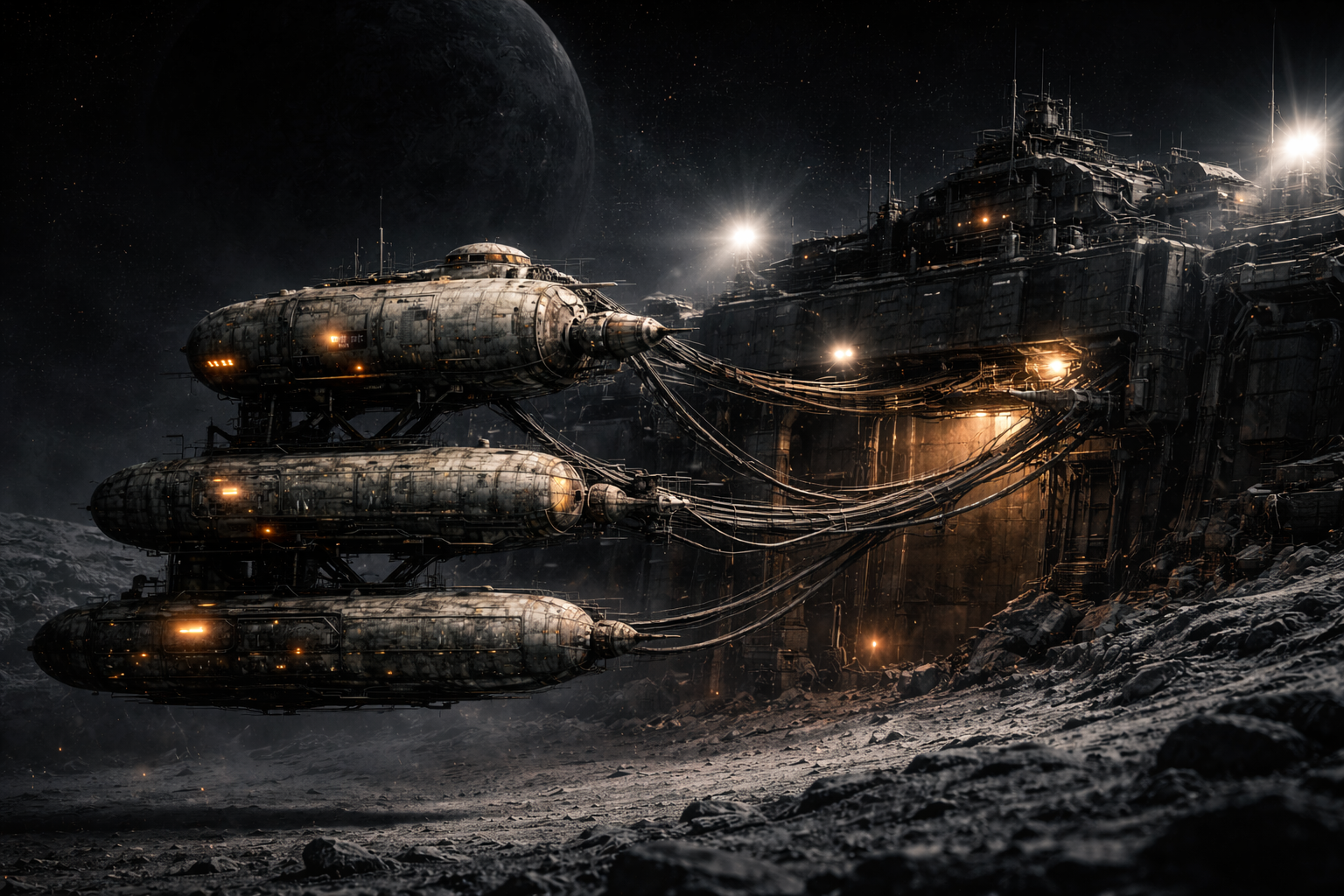
They docked. The clamps engaged, heavy and solid, the sound of real engineering built by people with funding. Through the hull Mara felt the cargo shift again, all four containers moving in unison, oriented toward the station.
The transfer took forty minutes. Fleischer-Yun's team came aboard in sealed environmental suits. Not standard hazmat, but something heavier, the faceplate's tinted dark. They didn't speak. They moved the containers with gravity trolleys, quickly, efficiently, and they didn't react to the filaments. They'd seen this before. They carried cutting tools designed for removing the organic material from the deck structure, and they excised the filament network from the Carrion Plea's hull with surgical precision, leaving clean metal behind.
While they worked, Mara watched from the upper hull viewport. The reactor couplings were already being loaded into her hold. The thermal refit kit. The coolant purge chemicals. Six weeks of survival, racked and secured.
Tomás came up beside her.
"They knew," he said. "They knew what was going to happen to the containers. They had the tools ready. The suits. The extraction procedure."
"Yes."
"The manifest said inactive."
"The manifest said what it needed to say for us to take the job."
"And you're fine with that?"
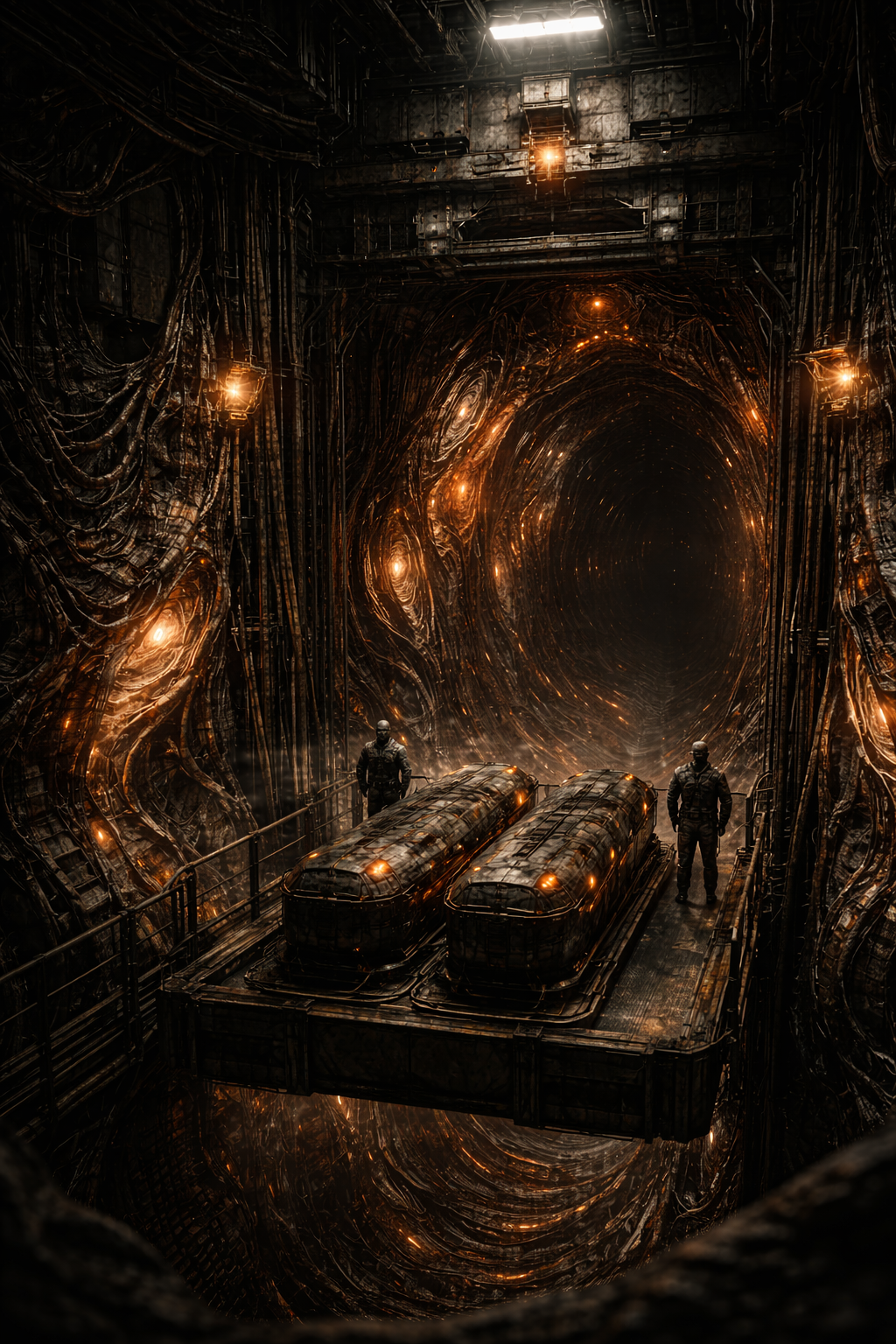
Mara watched the last container disappear into the station's freight elevator. Through the gap in the bay doors, she caught a glimpse of what lay beyond. A corridor that descended into the moon's interior. The walls were not metal. They were the same material as the filaments, amber and ribbed and pulsing with faint light. The station wasn't built on the moon.
It was grown.
"I'm not fine with anything, Tomás. I haven't been fine with anything in years. But we're alive. The ship is alive. And tomorrow there'll be another manifest."
She turned away from the viewport.
"That's the job."
XV.
Three days later, in a port bar at the edge of Ring 1, Koss set down her drink and said the thing nobody had said yet.
"I can still feel it. In the deck. Where the filaments were."
Mara didn't answer.
"They cut it all out. I watched them. Clean metal. I ran a diagnostic. Nothing. But the deck is warmer there. Half a degree. Maybe less. Below instrument threshold. But I can feel it through my boots."
Tomás was at the bar, peeling the label off his bottle in long strips and lining them up on the counter.
"Ship's clean," Mara said.
"I know it's clean. I'm telling you what I feel."
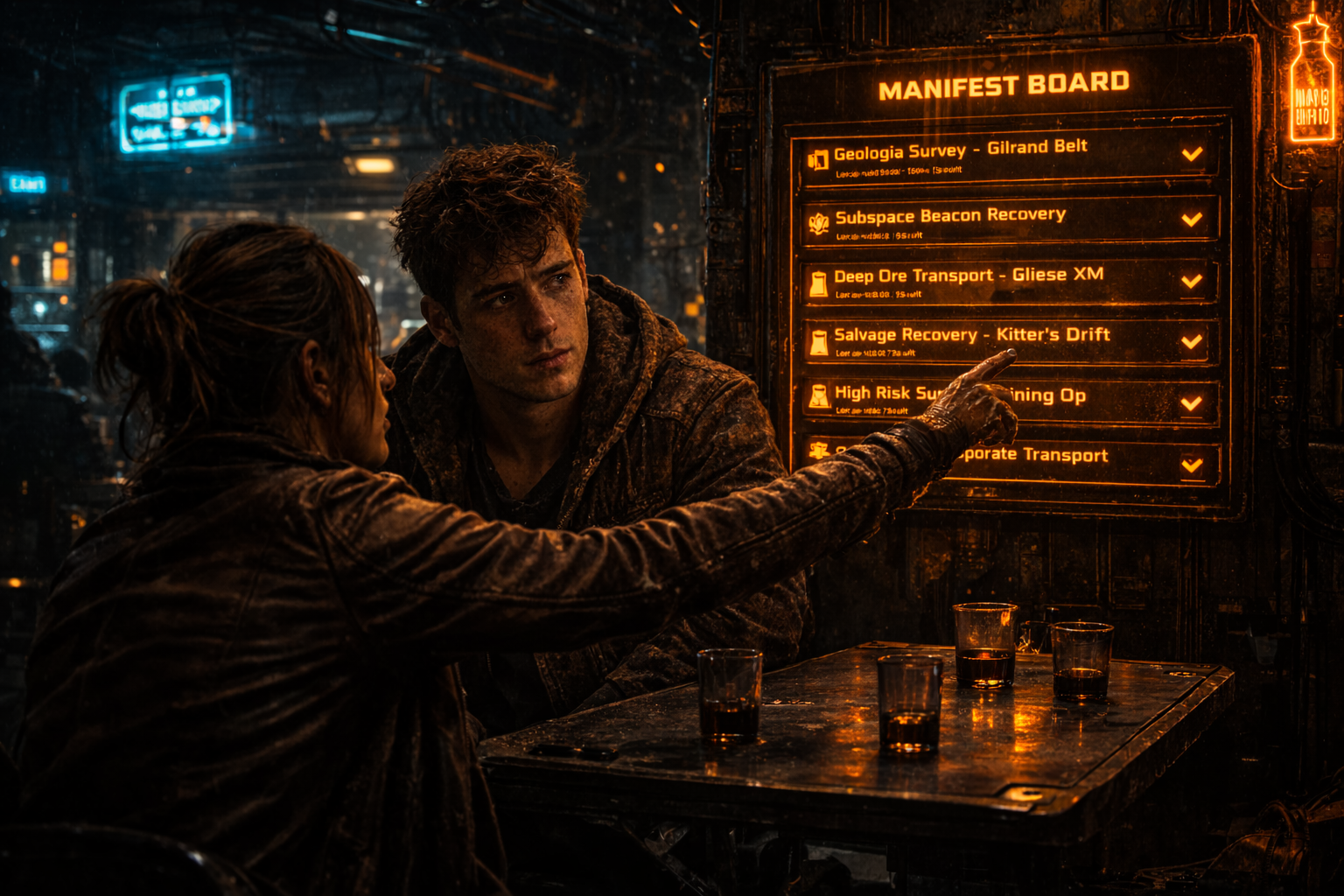
Mara finished her drink. Set down the glass. Looked at the manifest board on the bar's display: six new contracts, glowing amber on a dark background. Someone needed something moved. Someone needed something found. Someone needed something done that they couldn't do themselves or didn't want their name on.
"Next job pays in sensor components," she said. "We could upgrade the passive array. Longer range. We'd see the next corsair before it sees us."
Koss didn't look at her. She looked at the manifest board.
"Alright," Koss said. "Pull the manifest."
Mara reached for the board.